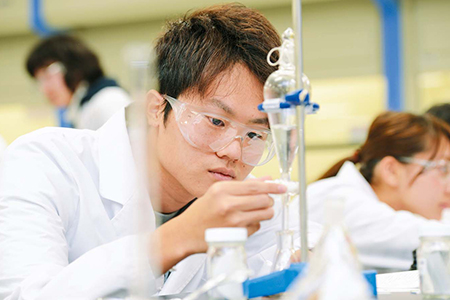
Department of Pharmaceutical Sciences
Training Pharmacists through Small-Group Education for Medicine and Life Sciences

As interest in health has increased, pharmacists in hospitals and drugstores now deal with patients more often.
In our Faculty of Pharmaceutical Sciences, we train specialists who can understand patients’ feelings with genuine humanity and who possess strong communication skills, while also acquiring the research competence necessary to support life sciences and the ability to contribute to interdisciplinary medical teams through extensive knowledge and advanced skills in pharmacy. We also provide careful support for each student by assigning a faculty advisor to a small student group and offering PBL-style practice.
We offer small-group education, with approximately 50 faculty members teaching 100 students each year under a fixed enrollment system.
We foster pharmacists who can explain disease mechanisms and pharmacological treatments and work as equal partners with physicians. Moreover, we educate pharmacists who can contribute to advanced medical care as well as community-based healthcare programs. #PBL=Problem-Based Learning
Licenses Available to Students
Students in the Department of Pharmaceutical Sciences are eligible to obtain the following licenses:
- Pharmacist
Faculty Members
Faculty information is available here.
Curriculum
Our curriculum is designed to educate pharmacists who can contribute to advances in medical technology and life sciences through a broad foundation spanning basic sciences and clinical pharmacy. Emphasis is placed on the development of professional integrity, strong ethical standards, and a sophisticated cultural and global perspective. Students also acquire logical thinking and problem-solving skills grounded in scientific evidence. In the first year, students study fundamental subjects such as physics, chemistry, and biology, as well as introductory pharmaceutical sciences. From the second year onward, they engage in advanced and cutting-edge studies in pharmaceutical science, medicine, and medical technology.
Curriculum Flow
- Foundations in Basic and Introductory Pharmaceutical Sciences
- Students study fundamental subjects, including introductory courses in humanism, along with essential basic sciences. They also take common subjects shared by all medical programs at the University, while some specialized pharmaceutical subjects are introduced from the first year.
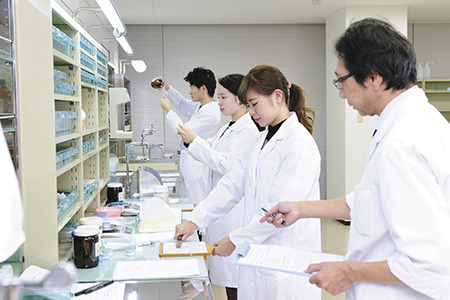
- Specialized Studies and Interdisciplinary Medical Care
- Students learn specialized foundational subjects and develop an understanding of interdisciplinary medical teams that deliver patient-centered healthcare.
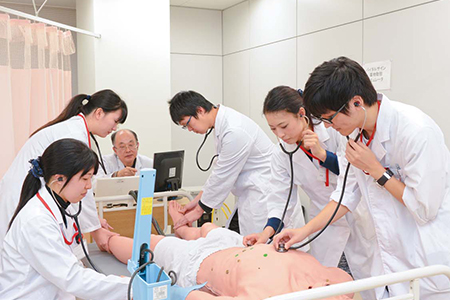
- Practical Experiments and PBL Practice
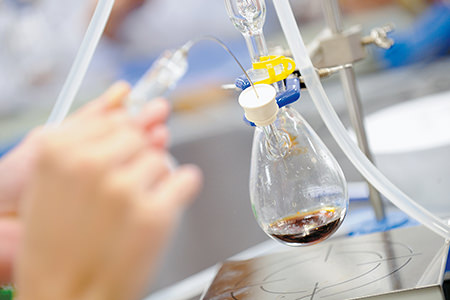
- Through practical experiments, students develop logical thinking and analytical skills. In addition, PBL-style practice enables them to integrate knowledge of diseases and pharmacotherapy.
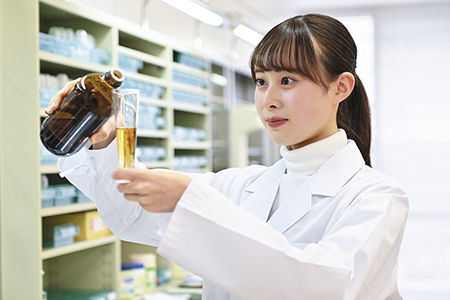
- Preparatory Practice and Pharmaceutical Common Achievement Tests
- After completing preparatory practice, students take the Pharmaceutical Common Achievement Tests (CBT and OSCE), which are required for practical training. These assessments evaluate the knowledge, skills, and professional attitudes essential for pharmacists.
- Practical Training
- Students acquire practical competence through 11 weeks of training in hospitals and 11 weeks in community pharmacies.

- Graduation Research and National Examination Preparation
- Students engage in advanced pharmaceutical studies and conduct a graduation research project under faculty supervision. They also prepare for the national pharmacist examination